How to Choose the Right Graphic Design Service for Your Business
TL;DR
Finding the right graphic design service goes beyond comparing prices or portfolios. The right creative partner can streamline workflows, maintain brand consistency, and help marketing teams scale content production without adding operational friction.
People judge brands in seconds. First impressions are formed in a few milliseconds. But they last months or years. That makes the choice of the right graphic design service one of the most powerful marketing decisions a business can make.
Get it right and your visuals build trust, build your brand’s recognition and compound across every campaign. Get it wrong and the results are detrimental to your brand’s credibility and long-term growth.
This guide breaks down the available options and practical tips for marketing teams and agencies to choose the right graphic design service for their business.
- Why Choosing the Right Design Service Matters for Your Brand
- Understanding Different Graphic Design Service Models
- Key Factors to Consider When Evaluating Design Services
- What Design Categories Does Your Business Need?
- Red Flags to Avoid When Selecting a Design Service
- Making the Final Decision: Choosing Your Design Partner
- Choosing the Right Graphic Design Service: FAQs
- Driving Growth by Collaborating With the Right Graphic Design Service
Why Choosing the Right Design Service Matters for Your Brand
Your visual identity is the core driver of customer trust and brand equity. With the global graphic design market surging past $56.9 billion, companies are racing to capture digital attention. Your visual identity directly affects how customers perceive and recognize your brand.
In an era of short attention spans, communicating to customers can be challenging. Besides, there is the point about changing consumer behavior. Some purchase decisions are made in split-seconds and some involve thorough research with the help of traditional search and LLMs. But amidst all this, there is one constant – people still judge brands entirely based on design. Data shows that 55% of first impressions of a brand come from their visuals alone.
On the other hand, poor design choices can damage credibility and weaken marketing efforts. So, yes, choosing the right graphic design services is more important now than ever. But teams looking for graphic design services should consider the operational challenges. A marketing team can lose several hours finding designers, explaining brand requirements, organizing feedback, chasing revisions, and managing files. Those hours become part of the real cost of design, even when they never appear on an invoice.
There is also a new issue – creative volume. Teams think AI makes it easier to generate more concepts and variations. But more content does not immediately mean better recognition. You need designs that don’t just look good but also represent your brand accurately.
Understanding Different Graphic Design Service Models
Here’s a quick snapshot of the graphic design service models for businesses and teams exploring the most popular options in 2026.
| Service Model | Typical Cost (2026) | Best For | Main Trade-off |
| Freelance designer | 45-200/hr or 150-1,500+ per project | One-off projects, recurring but limited needs, specific expertise | Availability and consistency over time |
| Design agency | 100-149/hr; 10,000-49,999 for many branding projects | Flagship rebrands, large campaigns, strategy-led creative | Higher cost and potentially slower cadence |
| Unlimited design service | 400–2000+/month | Ongoing, high-volume creative needs | Flat fee works best when design needs are steady |
| In-house designer | 41,000-59,000/year in salary | Consistent, high-volume design needs | Salary, benefits, software, equipment, and management overhead |
Choosing the right graphic design service starts with two questions: who will create the work, and how will you pay for it? These decisions affect cost, turnaround time, creative consistency, and how easily the service fits into your workflow.
Choosing based on who you work with
- Freelance designers – designers you hire either directly or through freelance marketplaces like Fiverr. They are experts in specific categories and work well for one-off projects.
- Design agencies bring a broader team with experience across branding, marketing, web design, and other creative needs. They can be useful for larger or strategy-heavy projects, although costs and processes may be more involved.
- In-house designers become part of your team and can provide consistent brand support and close collaboration.
- Unlimited design services give businesses access to an on-demand design team for a fixed monthly fee. They can be useful for companies producing frequent marketing assets, social graphics, presentations, ads, and other recurring creative.
Choosing based on how you pay for design
- Project-based pricing charges for a specific deliverable or defined scope. It works well for one-off projects such as logos, brand identity systems, campaigns, or website designs. Several design agencies and some freelance designers might charge project-based.
- Hourly pricing charges based on the designer’s time. This model can make sense when the scope isn’t immediately clear or if you think your project might benefit from extra room for experimentation or might evolve. Several freelance designers and some design agencies charge on an hourly basis.
- Monthly subscriptions or unlimited design services provide ongoing design support for a recurring fee charged monthly. Depending on the provider you choose, plans may include a dedicated team, multiple requests, revisions, and defined turnaround times.
The right graphic design service model depends on your workload, budget, project complexity, and how much ongoing support your business needs. Looking at both dimensions, who you work with and how you’re charged, gives you a clearer design service comparison before you commit.
Key Factors to Consider When Evaluating Design Services
Once you understand the models, the next step in identifying the right graphic design service is evaluating key parameters that matter in the long run. While there are several factors you need to understand, here are the most influential ones:
| Evaluation Metric | What to Look For | Why It Matters |
| Portfolio quality and design expertise | Do you need support with graphic design, web design, illustration, motion graphics or all of it? | Proves the provider can adapt to multi-channel marketing demands. |
| Workflow | Centralized project management dashboards. | Eliminates email clutter and keeps creative workflows easier to track and manage. |
| Pricing structure and transparency | Clear plans and no hidden fees. | Protects your marketing budget and prevents surprise bills. |
| Turnaround time | Fast and predictable. | Keeps fast-moving marketing campaigns agile and responsive |
Portfolio quality and design expertise
The chosen service’s or designer’s portfolio tells you what the service or designer can create. So it is something you cannot ignore before making a decision.
However, it does not tell you how well they will handle your design requirements.
Look for:
- Relevant design categories
- Different visual styles
- Evidence of brand consistency
- Experience in similar industries
- Work for similar audiences
- Digital and print experience
- Examples of complex projects
- Ability to work with diverse visual styles
These nuances matter because a beautiful design that does not align with your industry still misses the mark. So, experience in the kinds of designs you want, the formats, the visual styles, and niches matter.
Workflow
The best design can still feel like a mistake if it comes with a messy project and if the workflow becomes unmanageable. Missing or misplaced design files, details lost in chat conversations, attachments hidden in emails – that’s not what design workflows should look like.
So, the right graphic design service starts by simplifying and streamlining the workflow. Clear communication strategies and collaboration tools have become non-negotiable in modern marketing workflows. Especially with scattered teams and diverse stakeholders, you do not need an additional layer of chaos.
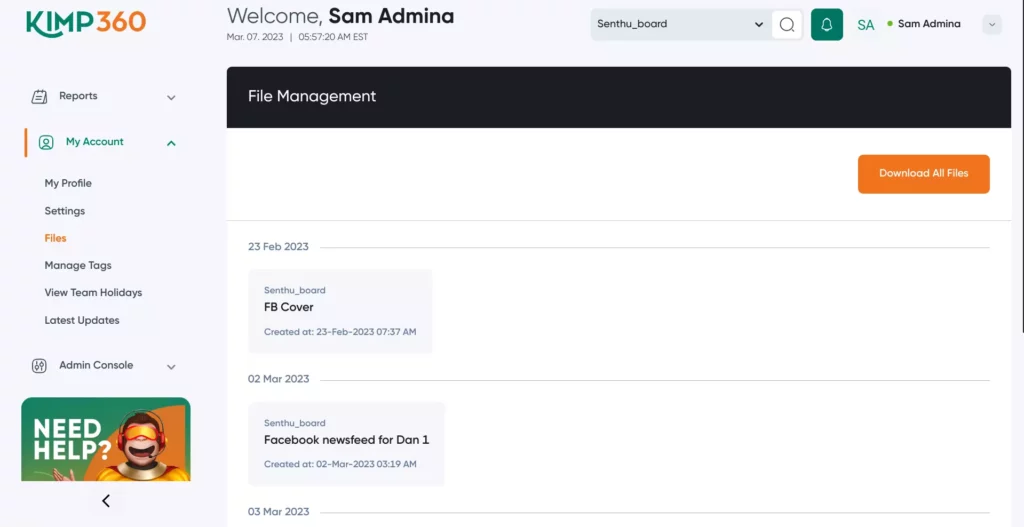
Teams benefit from seamless project management platforms like KIMP360. Teams that use tools like KIMP360 save hours spent on drafting briefs, organizing design files and keeping track of revisions.
The right graphic design service also ensures regular check-ins to ensure you are in the loop and the team is available with a response window for queries. This includes project-related and general queries.
Pricing structure and transparency
You are charged by the hour or based on the project or you pay a monthly fee. That’s what you see on the paper. However, there are more components to graphic design pricing than meets the eye.
The actual price you pay in the end depends on:
- Design fees
- Project management
- Revision costs for extra revisions
- Rush fees
- Sourcing costs
- Extra costs for source files/design ownership
When working with design agencies and freelancers, these factors should be clarified in the contract you sign. Most unlimited design services eliminate these additional cost components and charge a single clear monthly fee.
Here’s a snapshot of KIMP’s pricing.

Read more about it in our post about KIMP’s pricing and pick the right plan for your requirements.
Turnaround time
The right graphic design service simplifies turnaround times. While the actual time taken to complete a design depends on the complexity of the project and other factors, the chosen designer or service must be able to provide an estimate of the time required for the project. At least until the first draft. This will help you understand if the choice is practical and if it will help you meet your marketing deadlines.
The difference between 24 hours and five days can decide whether a launch ships on time. To understand what actual design output volumes look like, especially when you choose unlimited design services, read our blog on turnaround times.
What Design Categories Does Your Business Need?
Before finalizing on a provider based on the above factors, there is one crucial step: audit your design requirements. A service is only useful if it covers the work you actually produce. Map out your requirements across these categories and that instantly changes which model makes sense.
- Visual identity: Logos, typography, brand guidelines, and color palettes that form your foundational brand DNA.
- Marketing materials: High-converting social media graphics, paid ad creatives (Meta, LinkedIn, Google Display), email banners, and downloadable lead magnets.
- Web and app design: Landing page layouts, UI component styling, blog graphics, and wireframe assets that optimize digital conversion paths.
- Video content & motion graphics: Explainer videos, kinetic typography, and short-form videos for TikTok, Instagram Reels, and YouTube Shorts and video editing.
- Print materials: Event banners, product packaging, trade show displays, business cards, and direct mail collateral for omnichannel campaigns.
What designs among these do you need? How many do you need in each category and how often? Where do these designs sit in your current marketing workflow and goals?
Red Flags to Avoid When Selecting a Design Service
- Limited or restrictive revision policies that limit creative flexibility: if a provider does not talk about costs for extra revisions, including even the most basic tweaks or if they only support a very few revisions, design costs pile up when you wish to align the result with your expectations. This can happen particularly with projects like logo design where a lot of creative experimentation happens before finalizing a design.
- Unclear pricing and hidden fees: if the contract has too many fine print details and the slightest deviation leads to extra charges based on scope creep, you end up paying a lot more than what you had planned.
- Poor communication: minor delays are natural when working with designers or agencies handling multiple clients. And when they work in different time zones. However, if there is no clear structure or the communication happens through too many channels or if they are only available through one channel, it affects the collaboration.
- Poor response times during initial inquiries: in the early stages, if the team takes days to respond to you before you pay for their service, it might not be the right graphic design service to trust.
- Generic portfolios: same-style logos, just a few basic social media graphics and the same visual styles everywhere is a red flag you cannot ignore.
- No dedicated point of contact or constantly changing team members: if you have to explain your problem or talk about the whole history of the project with a different person each time, it quickly gets tedious. And your requirements and deliverables slip through the cracks.
Making the Final Decision: Choosing Your Design Partner
By this stage, you should have a clear understanding of the service models, pricing structures, workflows, and capabilities available. The final step in choosing the right graphic design service is evaluating the provider that best aligns with your goals.
Ask the following questions:
- What is the pricing model and is the overall cost in line with your budget?
- What’s included in the price and what is charged extra?
- How many revisions are included and how are revision loops handled?
- If you are working with an unlimited design service or design agency for multiple projects, will you be working with the same designer/team each time or a different one for each project?
- How will the provider ensure brand consistency?
- Will the provider support changes in priority or accommodate rush requests?
- What happens if you are not satisfied with the designs?
- Is there a free trial or money-back promise (especially when you choose an unlimited design service or an agency retainer)?
- Can the chosen model grow with your business or do you need to switch services for different kinds of design requirements?
Use these questions to evaluate the models and compare your options beyond the price tag. It’s always a good idea to test before making a long-term commitment. Whenever possible, start with a trial period, pilot project, or smaller engagement. This allows you to evaluate communication, creative quality, responsiveness, and workflow compatibility before committing to a long-term partnership.
Ultimately, the right graphic design service is the one that fits your workflow, supports your brand consistently, scales with your business, and delivers reliable creative support as your needs evolve.
Choosing the Right Graphic Design Service: FAQs
For simple one-off projects, collaborating with a freelance designer can be a cost-effective move. But as your design needs increase and when you need consistent, on-brand designs, unlimited design services are the more cost-effective alternative.
Yes. Some providers, especially unlimited design services like KIMP, now combine graphics, video, motion, web, and related creative services. If you need multiple disciplines, check whether they have dedicated capacity for each rather than assuming one team can handle everything at the same speed.
With generative AI deeply embedded in modern workflows, top-tier design services do not entirely avoid AI but use it with strict rules and protocols. There’s a lot of grey area around copyrighting purely AI-generated images or concepts. So, a reliable professional design service or subscription provider uses AI strictly as an assistant to speed up design workflows instead of replacing human creativity. For instance, at KIMP, AI helps enhance the efficiency of your design workflows but our designs still remain human. Every final asset comes from human creative direction and undergoes heavy human editing and brand customization so your designs stay unique and human.
Driving Growth by Collaborating With the Right Graphic Design Service
To conclude, there are many layers to choosing the right graphic design service. The pricing page and the portfolio page are perhaps what you are looking at. But look beyond them. Because design is a non-negotiable element in modern marketing and they play a critical role in a business’s growth.
If reliable, ongoing design support across multiple categories, the support of a dedicated design team for on-brand visuals and streamlined workflows that keep the designs flowing are what you need, choose KIMP.
Sign up now and start your 7-day free trial.